Most businesses hire a janitorial service without fully understanding what they are actually buying.
They assume it covers everything. Then the first deep clean does not happen, the floors look worn after three months, and the vendor says it was never in scope.
Here is exactly what janitorial service is, what it includes, what it does not, and how to make sure you get what your business actually needs.
What Is a Janitorial Service?
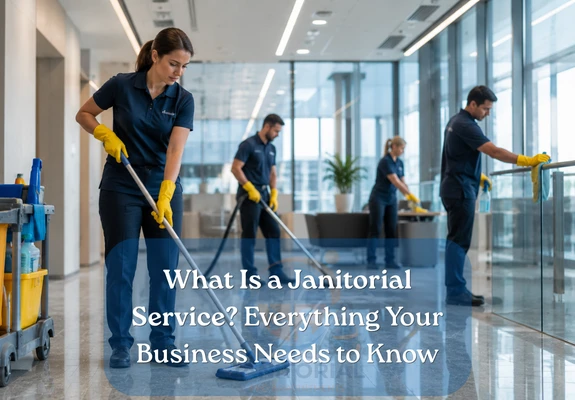
A janitorial service is a professional cleaning operation that maintains a commercial space on a recurring schedule — daily, several times a week, or weekly depending on the facility’s needs.
The core purpose is upkeep. Not restoration. Not deep cleaning. Consistent, scheduled maintenance that keeps a business environment clean, sanitary, and presentable between deeper periodic cleans.
Janitorial services are used by offices, schools, medical facilities, retail stores, warehouses, gyms, government buildings, and virtually any commercial space with ongoing foot traffic. The US janitorial services market is worth over $112 billion in 2026 — a reflection of how essential this service is to daily business operations across every industry.
💡 Pro Tip: Think of a janitorial service as the caretaker of your space — showing up consistently so you never have to think about it.
What Does a Janitorial Service Actually Include?
Standard janitorial service covers the routine maintenance tasks that keep a commercial space functional and presentable. While the exact scope depends on the contract, most janitorial services include:
General Office Areas –
- Emptying trash cans and replacing liners
- Dusting and wiping down desks, counters, and surfaces
- Vacuuming carpeted areas
- Mopping hard floor surfaces
- Spot-cleaning interior glass and partition walls
- Wiping light switches, door handles, and other high-touch points
Restrooms –
- Sanitizing toilets, urinals, and sinks
- Cleaning and polishing mirrors
- Restocking paper towels, toilet paper, and soap dispensers
- Sweeping and mopping floors with disinfectant
Breakrooms and Common Areas –
- Wiping down countertops, tables, and appliance exteriors
- Emptying trash and replacing liners
- Sweeping and mopping floors
Building Common Areas –
- Vacuuming or sweeping lobbies and hallways
- Wiping elevator buttons and door handles
- Spot-cleaning entry glass doors
💡 Pro Tip: Always request a written scope of work before signing. Verbal agreements about what is included create disputes — a detailed written scope protects both sides from day one.
What Is NOT Included in Standard Janitorial Service?
This is the section most people wish they had read before signing their first contract.
Standard janitorial service is routine maintenance. It is not everything. Here is what typically falls outside the scope:
- Deep carpet cleaning or extraction — Requires specialized equipment, usually a quarterly or annual add-on
- Floor stripping, waxing, or buffing — Periodic floor care is almost always a separate line item
- Exterior window washing — Interior spot-cleaning might be included, but exterior glass is a different job
- Post-construction or move-out cleaning — These one-time intensive cleans are priced differently
- Pressure washing — Parking lots, building exteriors, and loading docks are outside standard scope
- Biohazard or hazmat cleaning — Requires certified specialists, nothing to do with routine janitorial work
- Commercial kitchen or food service cleaning — Grease traps, hood systems, and deep kitchen sanitization need dedicated vendors
⚠️ Warning: If your facility has a commercial kitchen, medical procedure room, or data center, make sure those areas are spelled out explicitly in your contract. Assuming they are covered is how expensive misunderstandings happen.
How Is Janitorial Service Different From Cleaning Services?
People use these terms interchangeably all the time. They are not the same thing — and mixing them up is exactly why some businesses end up paying too much or getting too little.
Janitorial service is recurring maintenance. Same team, predictable schedule, consistent upkeep over time.
Cleaning services is a broader category. It includes janitorial work but also covers one-time jobs — deep cleans, move-out cleans, post-construction cleanups, carpet extraction, window washing.
A simple way to think about it:
- Need someone showing up every week to keep the office running? Janitorial service.
- Need a thorough clean before a big client event or after a renovation? Cleaning service.
- Need both on an ongoing basis? A full-service commercial cleaning contract.
→ For a full breakdown of how these two services differ, see our guide on janitorial vs cleaning services.
💡 Pro Tip: When calling vendors for quotes, say specifically what you need — ‘recurring janitorial service three times a week’ or ‘one-time deep clean before a move.’ Vague requests get you vague proposals.
Which Businesses Need Janitorial Service?
Short answer: any commercial space where people show up regularly and cleanliness actually matters.
- Office Buildings — The most common janitorial account in the US. Trash, restrooms, common areas, and floors on a recurring schedule.
- Medical and Dental Offices — EPA-registered disinfectants, strict sanitation protocols, and OSHA and CDC compliance documentation are all part of the job. Rates reflect that added complexity.
- Schools and Childcare Facilities — High foot traffic, cafeteria areas, multiple restrooms, and the need for non-toxic products that are safe around kids.
- Retail Stores — The customer-facing environment is the product. Dirty floors and dusty shelves cost sales. Most retail janitorial service runs in the evening or overnight.
- Gyms and Fitness Centers — High-touch equipment, locker rooms, and shower areas need frequent disinfection. This is not a once-a-week situation.
- Warehouses and Light Industrial — Large floor areas, loading docks, and shift worker restrooms. Consistent upkeep still matters for safety and compliance.
- Government Buildings — Formal bid process, strict compliance documentation, long-term contracts. Slower to win but among the most stable accounts available.
💡 Pro Tip: If your business has a reception area, waiting room, or showroom — a clean space is part of your first impression. Clients notice before anyone says a word.
How Often Should a Business Schedule Janitorial Service?
There is no universal answer, but foot traffic and facility type get you most of the way there.
Daily service makes sense for:
- Medical offices, clinics, and any healthcare environment
- High-traffic retail and hospitality spaces
- Schools and childcare facilities where sanitation standards are strict
Three to five times per week works well for:
- Mid-size offices with regular daily staff
- Gyms and fitness centers
- Government offices and municipal facilities
Once or twice per week is reasonable for:
- Small offices with limited staff and low foot traffic
- Administrative or storage areas that do not see heavy use
⚠️ Warning: If your space feels noticeably dirty within a day or two of each visit, the frequency is the problem — not the vendor. Under-scheduling is one of the most common mistakes businesses make.
How Much Does Janitorial Service Cost?
Janitorial service in the US is typically priced per square foot per visit, by the hour, or as a flat monthly rate. Here are the 2026 benchmarks:
| Facility Type | Facility Type | Monthly Cost (5,000 sq ft) |
|---|---|---|
| Standard Office | $0.08 – $0.15 | $400 – $750 |
| Medical / Dental | $0.15 – $0.35 | $750 – $1,750 |
| Retail | $0.10 – $0.18 | $500 – $900 |
| School / Daycare | $0.10 – $0.20 | $500 – $1,000 |
| Warehouse | $0.05 – $0.12 | $250 – $600 |
Hourly rates nationally average $35 to $75 in 2026, with high-cost markets like New York and Los Angeles running higher.
What moves the price up or down: number of restrooms, cleaning frequency, daytime vs overnight service, and any compliance requirements specific to your industry.
→ For a full breakdown of what drives janitorial pricing, see our commercial cleaning rates 2026 guide.
💡 Pro Tip: Always get at least three quotes — and make sure every vendor is quoting the exact same scope and frequency. A quote for daily service and one for three times a week are not comparable numbers, even if they look close on paper.
What to Look for When Hiring a Janitorial Service
Price is the easiest thing to compare. It is also the least useful filter when you are trying to find a vendor who will still deliver consistent service six months from now.
Here is what actually matters:
- Proper insurance and bonding — General liability at a minimum of $1 million per occurrence, workers’ compensation, and a janitorial surety bond. Ask for the certificate of insurance before the conversation goes further.
- Background-checked staff — Non-negotiable for any facility with after-hours access, sensitive areas, or compliance requirements.
- A written scope of work — Every task, every area, every frequency, in writing. No written scope means no real accountability when something is missed.
- A dedicated point of contact — One named person responsible for your account, not a general email inbox or call center phone tree.
- A clear quality assurance process — How do they check the work? How do you report a problem? What is the guaranteed response time? If they cannot answer these clearly, that tells you something.
- References from similar facilities — A vendor cleaning offices should give you references from office clients. Same goes for medical, retail, or industrial.
Before you sign anything, it is worth reading our guide on how to write a commercial cleaning proposal — it covers exactly what a strong vendor agreement should include from the client side too.
⚠️ Warning: The vendors who are hardest to reach after signing are usually the ones who were easiest to reach before. Ask specifically who your point of contact will be and how quickly they respond to issues.
CONCLUSION
A janitorial service is not a luxury and it is not complicated. It is a recurring maintenance system that keeps your business clean, safe, and professional without adding another item to your to-do list.
Know what is included, what is not, and what your facility actually needs — and you will find the right vendor faster and avoid the mistakes that cost time and money to fix.
Looking for a verified janitorial service for your facility? Janitorial Pro Appointments connects businesses across the US with vetted, professional cleaning companies. Contact us today.