
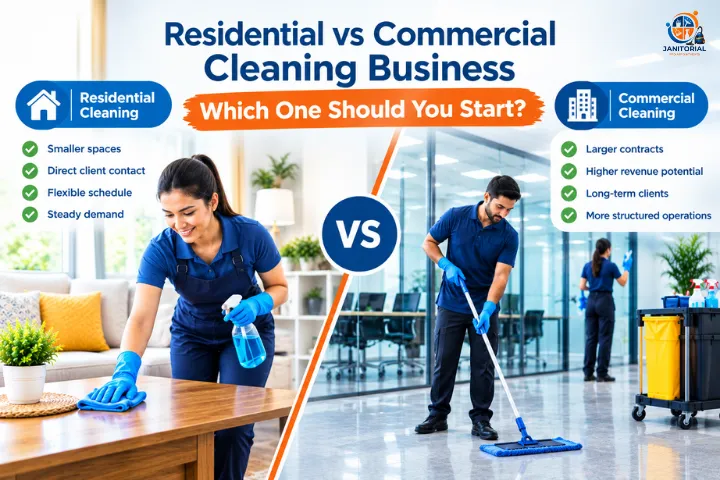
Short answer: residential is easier to start, commercial is harder to start but scales into a bigger, more stable business. Neither is universally “better” — the right choice depends on how much startup capital you have, how fast you want to grow, and how much risk you can absorb early on.
Here is an honest, numbers-based comparison of both paths, so you can pick the one that actually fits your situation instead of guessing.
1. The Core Trade-Off in One Sentence
Residential cleaning gets you earning fast with almost no startup cost. Commercial cleaning takes longer and costs more to get into, but a single contract can be worth more than five residential clients combined — and it does not disappear the moment the economy wobbles.
| 🗣️ Insight Residential cleaning is often the first thing cut from a household budget when money is tight. Commercial cleaning is treated as an operating expense, not a luxury — offices and facilities need it regardless of the economy. — Industry insight, 2026 |
2. Residential vs Commercial — Side by Side
| Residential | Commercial | |
|---|---|---|
| Startup cost | Low — $500 to $3,000 to start | Higher — insurance, bonding, commercial equipment |
| Working hours | Daytime, client’s schedule | Nights and weekends, after business hours |
| Contract length | Often one-off or loose recurring | Formal contracts, 6–12+ months typical |
| Income per client | Lower, but many small jobs | One contract can outvalue 5+ residential clients |
| Client relationship | Personal, in-home, high trust needed | Professional, facility manager or business owner |
| Growth ceiling | Capped by hours in the day | Scales with crew size and account count |
| Stability | More affected by economic downturns | More resistant — cleaning is a required expense |
3. Why Residential Is the Easier Starting Point
Residential cleaning has the lowest barrier to entry in the entire industry. No specialized equipment, minimal licensing in most states, and clients who often just want a reliable person more than a formal company.
- Lower startup cost — Basic supplies and your own labor is often enough to start
- Flexible hours — Most residential work happens during the day, Monday through Friday
- Faster first client — Word of mouth and local Facebook groups convert quickly for home cleaning
- Personal relationships — Repeat clients build loyalty fast when they trust you in their home
The trade-off: growth is capped by your own hours, and residential demand contracts first when household budgets tighten.
4. Why Commercial Is Harder to Start but Scales Further
Commercial cleaning requires more upfront investment — insurance, bonding, and often nighttime staffing — before you can even bid on your first account. But the payoff is a business that can genuinely scale past what your own two hands can do.
- Higher contract value — One office contract often pays more monthly than five residential homes combined
- Recurring, formal contracts — 6 to 12 month agreements create predictable, forecastable revenue
- Built to scale — Growth comes from adding crews and accounts, not just working more hours yourself
- Recession resistant — Businesses need clean facilities regardless of the economic climate
| ⚠️ Warning Do not jump into commercial contracts without proper insurance and bonding in place. Facility managers will not sign with an uncovered vendor, and one uninsured incident can end the business before it starts. |
→ For the full breakdown of what coverage is actually required, see our guide on janitorial business insurance requirements.
5. Which One Actually Fits Your Situation?
Choose Residential If…
- You have very limited startup capital
- You want to start earning within the first week or two
- You prefer daytime hours and in-person client relationships
- You are testing whether cleaning as a business fits you at all
Choose Commercial If…
- You can invest in insurance and bonding before your first pitch
- You want a business that can scale past your own personal labor
- You are comfortable with night or early-morning work schedules
- You want more predictable, contract-based revenue
| 💡 Pro Tip Many owners start residential to build initial cash flow and confidence, then transition into commercial once they have enough capital for proper insurance and bonding. It is a completely valid path — you do not have to pick one forever on day one. |
6. The Real Numbers Behind Each Path
Commercial janitorial businesses typically run at 10 to 25 percent profit margins once established, while residential cleaning often runs higher per job — 25 to 40 percent — because overhead stays lower when the owner is doing the labor directly.
→ For a full revenue and margin breakdown by business stage, see our guide on is a janitorial business profitable.
Bottom Line
There is no universally correct answer — only the right answer for your capital, risk tolerance, and growth goals right now. Residential gets you moving fast with minimal investment. Commercial takes more to start but builds toward a business that can genuinely scale and weather an economic downturn.
If you decide commercial is the path, the fastest way to grow past your first few accounts is getting consistently in front of decision-makers who are already looking for a vendor.
See how Janitorial Pro Appointments fills your calendar with real leads
→ [ Get a Free Quote ]


