Most cleaning businesses find out about insurance requirements the hard way — a property manager asks for proof of coverage before signing a contract, and suddenly you are scrambling to get insured in 24 hours.
This guide breaks down the janitorial business insurance requirements you actually need to know: what the law requires, what clients demand, and what you can honestly skip until your operation grows.
1. What Is Janitorial Business Insurance?
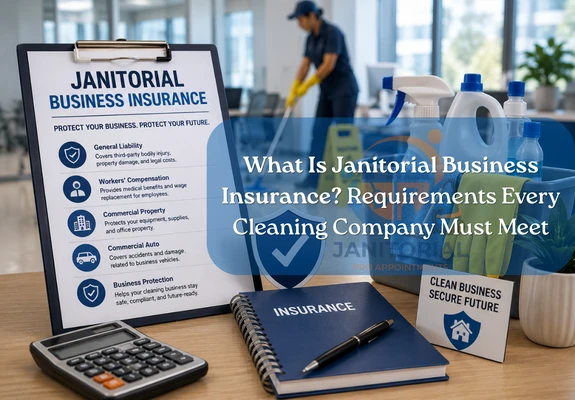
Janitorial business insurance is a set of commercial coverage policies that protect cleaning companies from financial losses caused by accidents, injuries, property damage, and legal claims. It is not one single policy — it is a combination of coverages that work together to protect different parts of your operation.
Cleaning work happens inside client property. Your crew handles chemicals, operates equipment, and works in spaces where one mistake can result in thousands of dollars in damage or legal costs. Without insurance, that cost comes directly out of your business.
Beyond protection, insurance is also a contract requirement. Most commercial property managers, facility directors, and corporate clients will not award contracts to uninsured cleaning companies — regardless of how competitive your pricing is.
🗣️ Insight: “Most facility managers require proof of at least $1 million in general liability coverage before allowing any cleaning crew on site.” — BOMA Industry Report, 2024
2. What the Law Actually Requires – Legal Requirements vs Client Requirements
Most cleaning business owners confuse what the law requires with what clients require. They are not the same thing. Legal requirements are the minimum floor. Client requirements are often higher — and they are what actually determine whether you get the contract.
Two coverages come up consistently across US states as legally required:
Workers Compensation — Required the Moment You Hire
In most US states, workers compensation is legally required the moment you hire your first employee. It covers medical expenses and lost wages when an employee is injured on the job.
Cleaning work involves repetitive motion, chemical handling, and slip risks. According to US Bureau of Labor Statistics data, janitorial workers consistently report above-average workplace injury rates. Without workers comp, one injury can result in lawsuits that far exceed the cost of coverage.
⚠️ Warning: Operating with employees and no workers compensation coverage is illegal in most states. Penalties include fines, back premiums, and personal liability for the business owner.
Commercial Auto — Required If Your Crew Travels to Job Sites
If your crew uses vehicles to travel between job sites, commercial auto insurance is legally required. Personal auto policies do not cover accidents that happen during business operations.
If an employee drives a company van to a job site and causes an accident, a personal auto policy will deny the claim. Commercial auto covers vehicle damage, medical expenses, and third-party liability for all business driving.
💡 Pro Tip: Even if employees use their own cars for work, check whether you need hired and non-owned auto coverage. It protects your business when staff drive personal vehicles for work purposes.
3. What Do Commercial Clients Require Before Signing a Janitorial Contract?
This is where most cleaning businesses get caught off guard. Client requirements are often stricter than legal requirements — and they vary by facility type.
General Liability — The Non-Negotiable
General liability insurance covers third-party claims for bodily injury and property damage during your cleaning work. If someone slips on a wet floor your crew just mopped, or cleaning chemicals damage a client carpet, general liability pays for medical bills, repairs, and legal defense.
Most commercial clients require a minimum of $1 million per occurrence and $2 million aggregate before signing any contract. Medical facilities, government buildings, and school districts often require higher limits.
💡 Pro Tip: Get your Certificate of Insurance before your first commercial pitch. Most property managers will ask for it before scheduling a walkthrough — not after.
Janitorial Bond — The Trust Signal Clients Ask For
A janitorial bond — also called a surety bond or fidelity bond — protects clients if one of your employees steals money or property while working on site. It does not protect your business. It protects your client.
Most commercial clients require bonding before allowing your crew unsupervised access to their facility. It is also a strong credibility signal when pitching new accounts — especially offices, medical facilities, and schools where staff work without direct supervision.
For a full breakdown of what bonding and insurance costs in 2026, check out our Janitorial Insurance Cost guide.
Workers Compensation Certificate — Clients Want Their Own Proof
Even if your state legally requires workers compensation, commercial clients will ask for their own certificate confirming your employees are covered. If an employee is injured on client property without coverage in place, the client can be held partially liable. Facility managers verify this before day one — every time.
4. Full Insurance Requirements at a Glance
| Coverage Type | Legally Required? | Client Required? | Priority |
|---|---|---|---|
| General Liability | No (most states) | Yes — almost always | Must have before day one |
| Janitorial Bond | No | Yes — commercial accounts | Get it before first pitch |
| Workers Compensation | Yes — if you hire | Yes | Required once you hire |
| Commercial Auto | Yes — if using vehicles | Often required | Required if crew travels |
| Tools and Equipment | No | Rarely required | Add when equipment grows |
| Umbrella Policy | No | Large contracts only | Add as contracts scale |
| Commercial Property | No | No | Only if you own a space |
5. Requirements by Business Size
Solo Operator — What You Need Before Your First Job
- General liability — Clients require it before your first commercial job
- Janitorial bond — Required for most commercial accounts
- Commercial auto — If you drive to job sites
As a solo operator with no employees, you are not legally required to carry workers compensation. But many commercial clients will still ask for it — confirm before pitching.
Small Team With Employees — The Core Stack
- General liability — Minimum $1 million per occurrence
- Janitorial bond — Required for all commercial accounts
- Workers’ compensation — Legally required in most states once you hire
- Commercial auto — Required if employees drive to job sites
- Tools and equipment coverage — Add when you invest in commercial-grade machinery
💡 Pro Tip: Bundle general liability with a Business Owners Policy if you have a physical office or storage space. It is usually cheaper than buying the policies separately.
Large Commercial Contractor — The Full Coverage Stack
- General liability — $2 million or more for large facility contracts
- Janitorial bond — Scaled to contract value
- Workers’ compensation — Required, rates based on total payroll
- Commercial auto — Per vehicle coverage for your full fleet
- Umbrella policy — Extends coverage beyond base policy limits for large contracts
- Employee dishonesty coverage — Protects against internal theft claims
⚠️ Warning: Government, hospital, and school district contracts often require additional insured status — meaning the client is listed as a covered party on your policy. Confirm this requirement before you bid.
Bottom Line
The janitorial business insurance requirements that matter most are not the legal minimums — they are what clients demand. General liability and bonding will come up before your first commercial contract. Workers’ compensation is required the moment you hire.
Get insured before you start pitching. A Certificate of Insurance closes more contracts than any sales script ever will.
Ready to land more commercial cleaning contracts? Janitorial Pro Appointments connects cleaning businesses across the US with verified, appointment-ready leads — so you spend less time cold calling and more time closing.
Book your free consultation today!
[ Get a Free Quote ]