Every janitorial business owner hits the same wall at some point.
The referrals that got you your first five clients have dried up. Word of mouth is too slow and too unpredictable to build a real pipeline on. And you are not sure what to do next — so you either stay stuck or start cold calling into the void and hope something sticks.
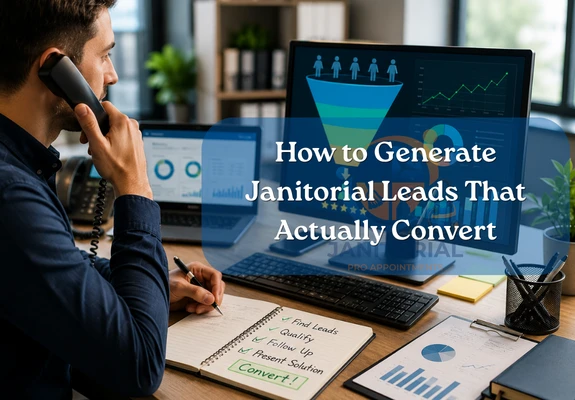
Generating janitorial leads consistently requires more than one channel and more than one tactic. Telemarketing is part of the picture — but only part of it. Here is the full picture, method by method, so you can build a lead generation system that actually produces new commercial accounts.
1. Janitorial Telemarketing — What It Is and When It Works
Janitorial telemarketing means calling businesses directly to introduce your cleaning services and qualify them as potential clients. Done well, it is one of the fastest ways to get in front of decision-makers — property managers, facilities directors, and office managers who are actively responsible for vendor selection.
The key word is done well. Most cleaning companies that try telemarketing in-house run into the same problems: inconsistent dialing, poor scripts, no follow-up system, and callers who are not trained to handle objections or navigate gatekeepers.
What Effective Janitorial Telemarketing Looks Like
- A verified prospect list — Not a random directory, but contacts matched to your target facility types and service area
- A short, specific opening — ‘We specialize in commercial cleaning for medical offices in your area and I wanted to introduce our services’ beats a generic cold call every time
- A clear ask — Booking a site walkthrough, not closing a contract on the first call
- A follow-up cadence — Most conversions happen on the third or fourth contact, not the first
- Tracking and reporting — Which calls connected, which led to walkthroughs, which converted
When Telemarketing Works Best
Telemarketing produces the best results when your target market is well-defined, your offer is clear, and you have the capacity to follow up consistently. It works especially well for entering a new geographic market quickly, targeting a specific industry like medical offices or property management companies, and filling gaps in your schedule between other inbound channels.
⚠️ Warning
Telemarketing without a follow-up system is just calling. The first call opens the door — the follow-up sequence is what walks you through it. If you are not tracking every contact and following up at least three times, you are leaving most of your potential conversions on the table.
2. Cold Email Outreach
Cold email is the written version of telemarketing — and in many markets, it gets a higher response rate because decision-makers can read and respond on their own time.
The difference between cold email that works and cold email that gets ignored is specificity. A generic ‘we offer cleaning services’ email goes straight to trash. An email that mentions the specific type of facility, references a relevant pain point, and offers something concrete gets read.
A Cold Email Framework That Gets Responses
- Subject line — specific and relevant: ‘Janitorial services for medical offices in [City]’ beats ‘Professional cleaning available’
- Opening line — one sentence about them, not you: ‘I noticed your clinic is in the [Name] medical plaza — we currently service three other facilities in that building’
- The offer — one clear ask: a free site walkthrough or a 15-minute call, not a contract
- Proof — one specific credibility signal: a client type you serve, a certification you hold, or a relevant result
- Call to action — one option, not three: ‘Would Wednesday or Thursday work for a quick walkthrough?’
Keep the email under 150 words. Shorter emails get read. Longer ones get skimmed and closed.
💡 Pro Tip
Send your cold emails from a business domain, not Gmail. A branded email address adds instant credibility and reduces the chance of landing in spam. It takes 15 minutes to set up and makes a measurable difference in open rates.
3. LinkedIn Prospecting
LinkedIn is the most underused lead generation channel in the janitorial industry — and one of the most effective for reaching commercial decision-makers.
The people who sign cleaning contracts are on LinkedIn every day: property managers, facilities directors, office managers, and building owners. A direct, professional message on LinkedIn gets read far more often than a cold email because the inbox is far less crowded.
How to Use LinkedIn for Janitorial Lead Generation
- Search by job title and location — ‘Facilities Manager [City],’ ‘Property Manager [City],’ ‘Office Manager [City]’
- Send a connection request with a short personal note — Two sentences, no pitch
- After connecting, send a brief introduction — Who you are, what you specialize in, and an offer for a free site walkthrough
- Engage with their content before messaging — A genuine comment on their post makes your name familiar before you reach out
- Keep every message under five sentences — LinkedIn messages that read like emails do not get responses
💡 Pro Tip
LinkedIn Sales Navigator allows you to filter by company size, industry, and seniority level — making prospecting far more targeted. At around $100 per month, it pays for itself quickly if you are consistently booking even one new walkthrough per week from the platform.
4. Local SEO and Google Business Profile
Every other method on this list requires you to go find the lead. Local SEO is the one method that brings leads to you — and the leads it generates are already looking for what you offer.
When a facility manager searches ‘commercial cleaning company near me’ or ‘janitorial service for medical office in [City],’ local SEO is what determines whether your business appears in the results. It takes longer to build than any other channel on this list, but the compounding return is unmatched.
The Three Pillars of Local SEO for Janitorial Businesses
Google Business Profile — Your most powerful free tool. Fill every section, post weekly updates, add real job photos, respond to every review, and enable messaging. An active, complete profile ranks significantly higher than a neglected one.
Website content — Pages optimized for your service area and the types of facilities you clean. ‘Commercial cleaning for medical offices in [City]’ as a page title is worth more than a generic homepage that says ‘we clean everything everywhere.’
Citations and directory listings — Your business name, address, and phone number listed consistently across Google, Yelp, Angi, Thumbtack, and local chamber directories. Inconsistency here hurts your ranking directly.
💡 Pro Tip
Publishing one well-written blog post per week on topics your target clients search for — like ‘how to choose a janitorial service’ or ‘commercial cleaning rates in [City]’ — builds local SEO authority faster than any other content strategy and brings in leads months after the post goes live.
5. Referral Programs
Referral leads convert at a higher rate than any other source. A prospect who was sent by someone they trust already believes in you before the first conversation. The problem is that most cleaning businesses leave referrals entirely to chance.
A referral program turns what happens randomly into something that happens consistently.
Building a Referral System That Runs Itself
- Ask at the 90-day mark — After you have proven your reliability, not on day one
- Be specific: ‘Do you know any other office managers or property contacts who might need cleaning?’ gets more results than a general ask
- Offer a one-month service credit for every referred client who signs a contract
- Follow up every referral within 24 hours — Warm leads go cold faster than any other type
- Thank the referrer immediately, whether the referral converts or not — The relationship matters more than the single lead
Who Your Best Referrers Actually Are
It is almost never your biggest client. It is your most satisfied one. A small office manager who genuinely loves your work will refer you more consistently than a large facility account that barely notices you are there.
Other strong referral sources: your accountant, your insurance broker, your equipment supplier, and other service businesses that work with the same commercial clients you do — pest control companies, HVAC contractors, and commercial landscapers all serve the same facility managers you are trying to reach.
💡 Pro Tip
Build a list of five to ten non-competing businesses that serve your target clients and reach out to propose mutual referrals. One relationship with a commercial HVAC company or property management consultant can produce more leads than months of cold outreach.
6. Government and Institutional Bidding
Government cleaning contracts are publicly posted, competitively bid, and open to any qualified vendor. They take longer to win than private accounts — the paperwork is heavier and the process is more formal — but once you are in, these accounts are among the most stable and highest-value in the industry.
Where to Find Government Janitorial Bids
- SAM.gov — All federal government contracts, free to search and register
- Your state’s official procurement portal — Every state posts facility service bids publicly
- DemandStar, BidNet, and BidSync — City, county, and municipal bids aggregated in one place
- Local school district and university procurement pages — Often posted directly on their websites
What You Need to Compete
- Active SAM.gov registration — Free, required for federal bids, takes about 30 minutes to set up
- NAICS code 561720 — Building Cleaning Services — listed on your registration
- A capability statement ready to attach — One page summarizing your company, services, insurance, and relevant experience
- Accurate pricing — Government bids are evaluated on total cost, compliance, and past performance, not just the lowest number
💡 Pro Tip
Start with small municipal contracts — a library, a community center, a government office under 10,000 sq ft. Win one, document it well, and use it as your government reference for larger bids. The first government contract is always the hardest.
7. Appointment-Setting Services
Every method above requires time, consistency, and patience before it produces results at scale. If you need new commercial accounts faster — or if you want to remove the cold outreach grind from your plate entirely — a professional appointment-setting service is the most direct path.
A janitorial appointment-setting service does the prospecting, qualifying, and scheduling for you. Instead of spending hours cold calling and emailing, you receive pre-scheduled meetings with verified decision-makers who are actively looking for a cleaning vendor. You show up, do the walkthrough, submit the proposal, and focus on closing.
What Separates a Good Appointment-Setting Service from a Bad One
- Leads are exclusive — Not shared with three other cleaning companies in your area
- Decision-makers are verified before the appointment is booked — Not receptionists, not gatekeepers
- Target industries and geography match your niche — Medical offices if that is your specialty, not random small businesses
- You receive full contact details and context before the meeting — Not a name and a phone number
Appointment-setting works best as a complement to your other channels — not a replacement for them. While a service fills your short-term calendar with qualified meetings, your SEO, referral program, and LinkedIn presence build the long-term pipeline that produces inbound leads without ongoing cost.
💡 Pro Tip
Before signing with any appointment-setting service, ask one question: ‘Can I speak with two or three current janitorial clients?’ A legitimate service will connect you without hesitation. One that cannot answer that question is not worth your budget.
Which Lead Generation Mix Works Best?
No single channel fills a pipeline by itself. The cleaning businesses that grow consistently in 2026 are using a combination of methods — typically two or three at a time, matched to their current stage of growth.
▪️Just starting out: Telemarketing and cold email to build initial accounts fast, LinkedIn to reach decision-makers directly, and referral program from day one.
▪️Established with 5 to 15 clients: Local SEO to build long-term inbound, referral program running consistently, and government bids for stable high-value accounts.
▪️Ready to scale aggressively: Appointment-setting service for consistent meeting volume, paired with local SEO for compounding inbound and a referral system that runs without you.
For more on building the systems that turn leads into long-term clients, see our guide on how to grow a cleaning business when you feel stuck.
CONCLUSION
Janitorial telemarketing gets you in the room. But building a real, consistent pipeline requires more than one channel working in isolation.
Pick two or three methods from this list that match where your business is right now. Build a system around them. Track what converts. Cut what does not. The cleaning businesses with full calendars are not the ones doing everything — they are the ones doing the right things consistently.
Ready to skip the cold calling and start receiving pre-qualified appointments with facility managers actively looking for a cleaning vendor?
Janitorial Pro Appointments connects cleaning businesses across the US with verified, ready-to-book leads.
[ Get a Free Quote ]