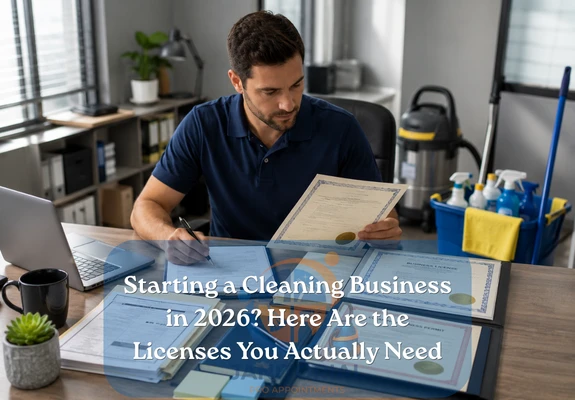
Most people spend hours Googling this and still walk away confused. That is because the answer actually depends on where you are, what type of cleaning you do, and how your business is set up.
So here is the plain version — no legal jargon, no unnecessary panic. Just what you need, when you need it, and what can honestly wait.
Step 1: The One License Every Cleaning Business Needs
Before anything else: A general business license.
This is the foundational document that says you are legally allowed to operate a business in your city or county. It is not cleaning-specific — it applies to almost every business type. And in most places, you need it before you take your first paid job.
Where to get it:
- Go to your city or county government website
- Search for ‘business license’ or ‘business registration’
- Fees typically range from $20 to $150 depending on location
- Most are renewed annually
💡 Pro Tip
Apply for your business license the same week you decide to start. It takes longer than expected in some cities, and you do not want to be waiting on paperwork when your first client is ready to sign.
Step 2: Business Structure and Registration
How you legally structure your business determines what registration paperwork you need to file — and how much personal liability you carry.
Your main options:
- Sole Proprietor — Simplest to start, no separate registration in most states, but your personal assets are not protected
- LLC (Limited Liability Company) — Most popular for cleaning businesses, separates personal and business assets, costs $50–$500 to register depending on state
- Corporation — More complex, typically unnecessary for small cleaning operations
Most cleaning business owners start as a sole proprietor and upgrade to an LLC once they land their first few contracts. Either way, if you are operating under a name that is not your legal name, you will need to file a DBA (Doing Business As) or fictitious name registration.
⚠️ Warning
Operating without the right structure means a client lawsuit could put your personal bank account and home at risk. An LLC costs a few hundred dollars. That protection is worth it.
Step 3: EIN and Tax Setup
An EIN (Employer Identification Number) is your business’s tax ID. Think of it like a Social Security number — but for your company.
Do you need one?
- Yes, if you plan to hire employees
- Yes, if you set up an LLC or Corporation
- Technically optional for sole proprietors with no employees — but strongly recommended anyway
Getting an EIN is free and takes about five minutes on the IRS website. There is no reason to delay this one.
💡 Pro Tip
Get your EIN before you open a business bank account. Most banks require it, and separating business finances from personal from day one saves you hours at tax time.
Step 4: State-Level Permits and Requirements
This is where things vary. There is no national cleaning business license in the US. Instead, requirements depend on your state, and sometimes your city or county.
Common state-level requirements:
- Business registration with the Secretary of State (usually for LLCs and Corporations)
- Sales tax permit (if your state taxes cleaning services — some do, some do not)
- Occupational license in certain counties or municipalities
A few states where cleaning businesses most commonly run into requirements:
| State | Key Requirements |
|---|---|
| California | Business license required in most cities. Contractor license needed for janitorial services over $500. |
| Texas | No state license, but city/county permits vary. Sales tax registration required. |
| Florida | Business license through county. Some counties require occupational license. |
| New York | NYC requires a Home Improvement Contractor license for some cleaning work. |
| Illinois | Business registration with Secretary of State. City-level business licenses vary. |
| Georgia | Business license through county or city. No statewide cleaning license. |
| Pennsylvania | Local business privilege license in many municipalities. |
⚠️ Warning
Do not assume your state has no requirements just because you cannot find them easily. Call your county clerk’s office directly — one 10-minute phone call can save you from a fine later.
Step 5: Insurance (What Counts as a License Requirement)
Insurance is not technically a license. But many clients — especially commercial clients — will not sign a contract without proof of it. In some states, certain types of insurance are legally required before you can operate.
What you need before day one:
- General Liability Insurance — Covers property damage and bodily injury claims. Most commercial clients require at least $1M per occurrence. Costs $400–$1,500 per year depending on revenue.
- Workers’ Compensation Insurance — Required in most states the moment you hire your first employee, even part-time.
Optional but worth having:
- Janitorial Bond — Protects clients if an employee steals from their property. Many clients ask for this, especially in residential work.
- Commercial Auto Insurance — If you are using a vehicle for the business, personal auto policies typically exclude business use.
💡 Pro Tip
Get a Certificate of Insurance (COI) from your insurer and attach it to every proposal you send. Clients notice. It closes more deals than almost anything else you can do.
→ Want the full breakdown on what janitorial insurance costs in 2026? See our commercial cleaning rates guide.
Step 6: Licenses for Specialized Cleaning Services
Standard office and commercial cleaning typically does not require a specialized license. But some types of cleaning work do — and operating without the right credentials in these areas is a serious liability.
| Service Type | What You May Need |
|---|---|
| Medical / Healthcare Cleaning | OSHA Bloodborne Pathogen certification. Some facilities require GBAC STAR or similar training. |
| Biohazard / Crime Scene Cleaning | State biohazard handler certification. Specific disposal licensing. |
| Post-Construction Cleaning | Contractor license in some states (California threshold: jobs over $500). |
| Industrial / Manufacturing | Hazardous materials handling training. OSHA 10 or 30 certification recommended. |
| Carpet and Floor Care | No license required, but IICRC certification improves credibility. |
⚠️ Warning
Do not pitch medical or biohazard clients until you have the right credentials in place. Walking in unprepared does not just cost you the job — it closes that door permanently with that contact.
Step 7: What Can Actually Wait Until After Day One
Here is what nobody tells you: You do not need everything on day one. Some things can — and should — wait until your business is actually generating revenue.
Can wait:
- IICRC or specialty cleaning certifications — Get these when you start targeting those niches
- Commercial auto insurance — Only required if using a vehicle for business (personal auto may cover you until you scale)
- Janitorial bond — Worth getting, but not legally required in most states
- Contractor’s license — Only needed for specific service types or states
Cannot wait:
- General business license — Needed before your first job
- Business structure registration — Do this first
- EIN — Free, takes five minutes, get it now
- General liability insurance — Most commercial clients require this before signing anything
💡 Pro Tip
Focus on the four things above that cannot wait. Everything else can be added as your business grows. Starting paralyzed by paperwork is how most cleaning businesses never actually start.
CONCLUSION
Don’t Overthink It
Every cleaning business needs a general business license, the right structure, an EIN, and general liability insurance. Everything beyond that depends on your state, your city, and what type of cleaning you do.
Do not let the paperwork slow you down. The four things above can be handled in a week. After that, go get your first client.
Looking to land commercial cleaning clients faster?
Janitorial Pro Appointments connects cleaning businesses across the US with verified, ready-to-book commercial leads.
[ Get a Free Quote ]