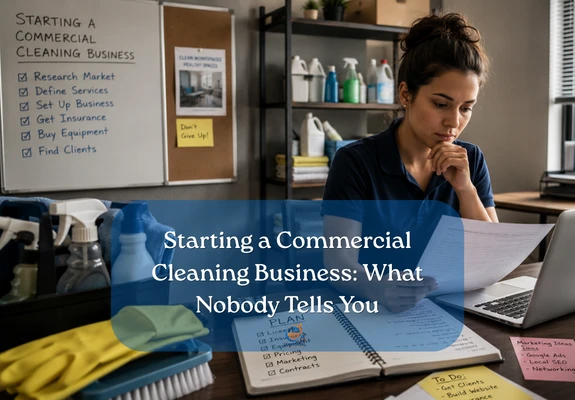
You can start a commercial cleaning business with less than $1,000.
No degree. No office. No fancy equipment to begin with.
But here is what most “how to start” guides skip — the part where people run out of clients in month three, underprice their first contracts, or hire too fast and watch their margins disappear.
This guide covers all of it. The setup, the strategy, the mistakes, and the shortcuts that actually work.
Step 1: Understand The Industry – What You Are Actually Getting Into
Commercial cleaning is not glamorous. But it is recession-resistant, high-demand, and one of the few service businesses you can genuinely start with almost nothing.
The US commercial cleaning industry generates over $117 billion annually. Office buildings, medical facilities, schools, gyms, warehouses, and retail stores all need professional cleaning — and most of them are looking for vendors they can actually rely on.
The real barrier to entry is not money or equipment. It is consistency and professionalism. The cleaning companies that fail are almost always the ones that could not show up reliably, not the ones that bought the wrong mop.
💡 Pro Tip: Before you register your business, spend two weeks cleaning for free or at a steep discount for one small commercial space. A real church hall, a small office, a local gym. You will learn more in those two weeks than any course will teach you — and you will know for sure if this business is right for you.
Step 2: Choose Your Niche Before You Register Anything
The biggest mistake new cleaning business owners make is trying to serve everyone.
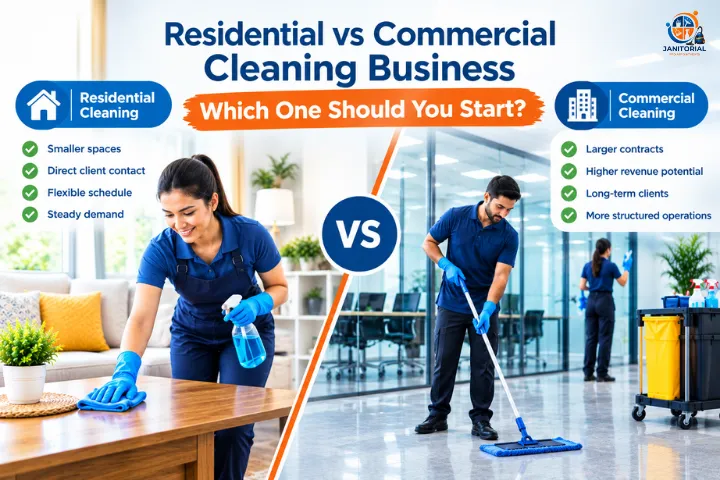
Residential and commercial cleaning require different equipment, pricing, insurance, and marketing. And within commercial cleaning, each facility type has its own compliance requirements, decision-makers, and pricing expectations.
Pick one niche and build around it from day one.
The most accessible niches for new cleaning businesses:
- Small offices (under 5,000 sq ft) — easiest to win, predictable schedules, good starting point
- Medical and dental offices — higher rates, strict standards, longer contracts once you are in
- Retail stores — evening and weekend work, high emphasis on appearance
- Schools and childcare facilities — background checks required, reliable long-term accounts
- Warehouses and light industrial — large spaces, floor care heavy, less competitive
💡 Pro Tip: Start with small offices to build your portfolio and cash flow. Once you have three to five accounts documented with testimonials, use that proof to move into higher-paying niches like medical or institutional cleaning.
Step 3: Set Up Your Business the Right Way
This step is boring. Do it anyway.
Skipping proper business setup is the fastest way to lose a commercial contract before it starts. Facility managers and procurement teams screen vendors for legal and financial credibility before anything else.
What you need before approaching your first commercial client:
- LLC or corporation — protects your personal assets, looks professional to clients
- Local business license — requirement varies by city and state, check your municipality
- EIN from the IRS — required for invoicing, payroll, and opening a business bank account
- Dedicated business bank account — keeps finances clean and makes tax time manageable
- Business email address — a Gmail with your name looks unprofessional to corporate clients
⚠️ Warning: Do not operate as a sole proprietor without an LLC. One slip-and-fall on a client’s property, one damaged piece of equipment, and you are personally liable. The LLC filing fee is $50 to $200 depending on your state. It is the cheapest protection you will ever buy.
Step 4: Get the Insurance and Certifications You Actually Need
Insurance is not optional in commercial cleaning. It is the entry ticket.
Most commercial clients will ask for your certificate of insurance before they agree to a walkthrough. If you cannot provide it immediately, you lose the opportunity to a competitor who can.
Minimum insurance requirements for commercial cleaning:
- General liability insurance — minimum $1 million per occurrence, most clients require this
- Workers’ compensation — legally required in most US states the moment you hire anyone
- Janitorial surety bond — protects clients against theft or accidental damage, builds trust immediately
- Commercial auto insurance — if you are driving a vehicle to client sites, personal auto insurance does not cover business use
Certifications worth getting early:
- ISSA Cleaning Industry Management Standard (CIMS) — recognized across commercial sectors
- OSHA 10 certification — required by some medical and government clients
- Green cleaning certification — strong differentiator for corporate and institutional accounts
💡 Pro Tip: Once your insurance is active, request a digital copy of your certificate of insurance and save it to your phone. When a prospect asks for it — and they will — send it within minutes. That speed alone signals professionalism and closes more first meetings than you would expect.
Step 5: Buy Equipment — But Only What You Need to Start
New cleaning business owners consistently overbuy equipment before they have a single client.
Start lean. Your first five clients do not need a $3,000 auto-scrubber. They need reliable, consistent cleaning with professional-grade supplies.
Your starter equipment list (under $800 total):
- Commercial-grade vacuum — $150 to $250 (Hoover or ProTeam are solid starting points)
- Microfiber mop system with bucket and wringer — $60 to $100
- Microfiber cloths (30+ pack) — $30 to $50
- Commercial cleaning chemicals — multi-surface cleaner, disinfectant, glass cleaner, floor cleaner — $80 to $120
- Caddy or rolling cart — $40 to $80
- Trash liners, gloves, paper towels — $50 to $80
- Branded polo shirts or uniforms — $60 to $100
⚠️ Warning: Do not lease or finance heavy equipment before you have consistent monthly contracts to support the payment. Equipment debt with no guaranteed revenue is one of the most common ways new cleaning businesses collapse in year one.
Step 6: Price Your Services to Make Real Money
Most new cleaning businesses underprice. They win the contract and then realize they are making less per hour than they did at their last job.
Price based on cost, not on what you think clients want to hear.
Your pricing formula:
- Calculate your labor cost first — Labor is 50% to 70% of your total contract cost. Use a production rate of 2,500 to 4,000 square feet per hour for standard office cleaning depending on layout and detail level.
- Add supplies and equipment depreciation — typically 5% to 10% of contract value
- Add overhead — insurance, fuel, uniforms, phone, admin — typically 15% to 25% of revenue
- Add your profit margin — target 15% to 30% net margin minimum
US commercial cleaning rate benchmarks:
- Standard office cleaning: $0.08 to $0.20 per square foot per visit
- Medical facilities: $0.15 to $0.35 per square foot
- Retail stores: $0.10 to $0.18 per square foot
- Warehouses and industrial: $0.05 to $0.12 per square foot
💡 Pro Tip: When you are new, do not go below your fully-loaded cost just to win a contract. A client who pays too little will demand too much, leave for a cheaper option the moment one appears, and drain your time and energy in the process. Price to attract clients who value reliability — they stay longer and refer others.
Step 7: Get Your First Clients
This is where most guides go vague. Here is what actually works when you are starting from zero:
▪️ Start With Your Network
Tell everyone you know that you have launched a commercial cleaning business. Former colleagues, neighbors, church contacts, LinkedIn connections. Ask specifically: “Do you know anyone who manages an office or commercial space?” One warm introduction is worth fifty cold calls.
▪️ Walk In to Local Businesses
Drive through office parks, medical plazas, and small retail strips in your area. Walk in and ask to speak with the office manager or facilities contact. Bring a one-page capability statement and your insurance certificate. You will get turned away often. You only need one yes to start.
▪️ Cold Email Property Management Companies
Property management firms manage multiple commercial buildings at once. One relationship can open the door to several accounts. Send a short professional email — three paragraphs maximum — introducing your company, attaching your insurance certificate, and offering a free site walkthrough.
▪️ Use a Janitorial Appointment-Setting Service
If you want to move faster without the grind of cold outreach, appointment-setting services connect cleaning businesses with verified decision-makers who are actively looking for a vendor. You receive a pre-scheduled meeting — you just show up, do the walkthrough, and close.
💡 Pro Tip: Your first goal is not to land a $5,000 per month contract. Your first goal is to land anything that pays, get it documented with photos and a testimonial, and use that as proof for the next pitch. The first three accounts are the hardest. After that, the portfolio does most of the selling.
Step 8: Deliver and Retain
One client who renews for three years is worth more than five clients who each leave after six months.
Retention is built before the contract is even signed — through your proposal, your walkthrough, and the expectations you set. Then it is maintained through consistency.
What retention-focused service looks like:
- Custom cleaning checklist for every building — never use a generic one-size-fits-all list
- Time-stamped job verification by whoever leads the shift
- Monthly summary report sent to the client — what was done, anything flagged, anything coming up
- A single named point of contact for every account, not a general phone number
- Complaints acknowledged within 2 hours and resolved within 24 hours, no exceptions
🗣️ Industry Insight: “The number one reason facilities managers switch cleaning vendors is not price — it is poor communication and inconsistency. They want to know immediately when something goes wrong, not discover it themselves.” — Building Owners and Managers Association (BOMA), 2024 Facilities Management Survey
⚠️ Warning: The most common reason new cleaning businesses lose their first commercial contracts is not poor cleaning — it is a missed visit without notice. One unexplained no-show early in a relationship can end a contract permanently. Communicate before you miss, not after.
Step 9: Hire Without Breaking Your Business
The instinct when you get busy is to hire fast. Resist it until the numbers actually support it.
Before hiring your first employee, make sure:
- You have at least two to three recurring contracts generating consistent monthly revenue
- You have enough work to keep a part-time employee busy for at least 15 hours per week
- You have documented your cleaning process for every building you service
- You have workers’ compensation insurance in place — required by law in almost every state the moment you have an employee
Where to find reliable cleaning staff:
- Indeed and ZipRecruiter for volume applicants
- Local Facebook community groups — often faster than job boards for part-time work
- Referrals from current employees once you have them — the highest quality source
💡 Pro Tip: Hire for reliability and attitude, not experience. Cleaning technique is teachable in a day. Showing up on time and taking pride in the work is not. Your documented process handles the training — your hiring should focus entirely on finding people who will actually follow it.
Step 10: Scale With Systems, Not Just More Clients
Adding clients without adding systems does not create growth. It creates stress, inconsistent quality, and client churn.
Before you take on your next five accounts, make sure these three systems are working:
- Job management software — Jobber, Swept, or ZenMaid handle scheduling, invoicing, time tracking, and client communication in one place. Set this up before you have more than three accounts.
- Account-specific checklists — every building gets its own scope document that your team follows every visit. This is how you maintain quality when you are not physically on-site.
- Hiring and onboarding process — a written training protocol, a probationary evaluation period, and a clear standard for what good looks like at your company.
💡 Pro Tip: The cleaning companies that scale past $500,000 in annual revenue are almost never the best cleaners. They are the best operators. Build your systems early — before you feel like you need them — and growth becomes manageable instead of chaotic.
CONCLUSION
Starting a commercial cleaning business is straightforward. Building one that actually lasts takes a few things most people skip — the right niche, real pricing, a system for retention, and a plan for growth that does not depend on you doing everything yourself.
You now have the blueprint. The rest is execution.
If you want to accelerate the client acquisition part, Janitorial Pro Appointments connects cleaning businesses across the US with pre-qualified, verified appointments — so you can spend less time cold calling and more time closing. Get started here.