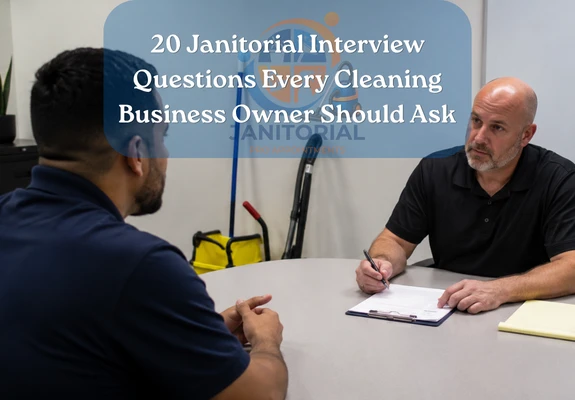
Most janitorial interviews go like this: you ask if someone has experience, they say yes, you give them the job, and two weeks later they stop showing up.
The problem is not that you hired the wrong person. It is that you asked the wrong questions.
A resume tells you where someone has worked. The right interview questions tell you whether they will actually show up, take ownership, and represent your company well on a client site at 10pm when no one is watching.
These 20 questions do that. They are organized into five categories — reliability, attitude, experience, situational, and professionalism. Use the ones that matter most for the role you are filling.
▪️ Before You Start — What You Are Really Screening For
Cleaning technique is teachable. Equipment can be learned in a day. What you cannot train into someone is the habit of showing up on time, taking pride in the work, and handling problems without needing to be managed every step of the way.
Every question in this list is designed to surface one of three things:
- Reliability — Will they show up consistently, on time, without excuses?
- Attitude — Do they take ownership of their work or look for reasons things are not their fault?
- Judgment — Can they handle unexpected situations on a client site without calling you for every decision?
💡 Pro Tip
Do not just listen to the answer — listen to how they answer. Candidates who blame past employers for everything, give vague non-answers, or cannot recall a single specific example are showing you exactly who they are.
Category 1: Reliability
These questions reveal the most important thing about any janitorial hire — whether they will actually be there when they are supposed to be.
Q1: What does your typical week look like right now?
Why it matters: You are checking for scheduling conflicts, other commitments, and whether their availability actually matches the role. Candidates who hesitate or give vague answers often have reliability issues they are not disclosing.
Q2: Tell me about a time you had to cover for someone at short notice. What did you do?
Why it matters: Reliable employees have done this — and remember it. Candidates who cannot think of an example may not be as dependable as they seem.
Q3: What would you do if you woke up sick on a day you were scheduled to clean a client site?
Why it matters: You want to hear: ‘I would call as early as possible.’ Red flags: ‘I would just not go’ or ‘I would text when I got up.’ How someone handles a missed shift matters more than the missed shift itself.
Q4: Have you ever left a job without notice? What happened?
Why it matters: Most people have a story here. What you are listening for is whether they take any responsibility or blame the employer entirely. Patterns of abrupt departures predict future behavior.
Category 2: Attitude and Work Ethic
Attitude is the hardest thing to train. These questions surface it quickly.
Q5: Tell me about a time your work was criticized. How did you handle it?
Why it matters: Good candidates can recall a specific example and describe what they did differently. Candidates who say they have never been criticized — or who immediately justify why the feedback was wrong — are a concern.
Q6: What does doing a good job mean to you?
Why it matters: You are looking for specifics — ‘the client walks in and everything is exactly where it should be’ — not generalities like ‘working hard.’ Specific answers signal someone who actually thinks about quality.
Q7: Have you ever noticed something wrong on a job that was not your responsibility? What did you do?
Why it matters: The answer reveals ownership. Did they fix it, flag it, or ignore it? In commercial cleaning, noticing problems that fall outside your checklist and handling them appropriately is what separates average cleaners from excellent ones.
Q8: What is the most physically demanding job you have had? How did you manage it?
Why it matters: Janitorial work is physical — standing for hours, lifting, bending, moving equipment. You want to know they understand what they are signing up for and have handled something similar before.
Category 3: Cleaning Experience
Experience matters, but not in the way most employers think. These questions reveal quality of experience, not just quantity.
Q9: Walk me through how you would clean a commercial restroom from start to finish.
Why it matters: You are not looking for perfection — you are looking for process. Someone who has done this before will describe steps naturally. Someone who has not will give a vague or incomplete answer.
Q10: What cleaning chemicals have you used before? Are there any you are not comfortable with?
Why it matters: Familiarity with commercial-grade products and safety awareness both surface here. A candidate who has only used household products will need more training. Someone who cannot name a single product raises questions.
Q11: Have you ever cleaned a medical or healthcare facility? What was different about it?
Why it matters: If the role involves medical accounts, this is critical. If not, the answer still reveals whether the candidate understands that different facilities have different standards — a sign of professional maturity.
Q12: Tell me about the largest facility you have been responsible for cleaning. How did you manage your time?
Why it matters: Time management in large commercial spaces is a real skill. This question reveals whether the candidate has worked at commercial scale before or is coming from residential or small-space experience only.
Category 4: Situational and Problem-Solving
These questions reveal judgment — what someone actually does when things go wrong on a client site with no one around to ask.
Q13: You arrive at a client site and realize you forgot an important piece of equipment. What do you do?
Why it matters: You want a practical, proactive answer — ‘I would call immediately and either go back to get it or communicate clearly about what I can still complete tonight.’ Candidates who say they would just figure it out or skip the affected areas without telling anyone are showing poor judgment.
Q14: You are cleaning an office and you notice a water leak coming from the ceiling. No one else is on site. What do you do?
Why it matters: The right answer involves notifying the appropriate people immediately — you, the client, or both. Someone who says they would just keep cleaning or wait until their next shift is not someone you want representing your company on a client site.
Q15: A client contacts you directly to ask you to do something outside your normal scope. How do you handle it?
Why it matters: This reveals whether the candidate understands professional boundaries and the importance of scope. The right answer is to be polite, explain they would need to check with the supervisor first, and flag it to you. Saying yes immediately is a problem.
Q16: You finish your shift and realize you missed cleaning one area. Your supervisor is not available. What do you do?
Why it matters: Accountability without supervision is what commercial clients pay for. You want to hear: ‘I would go back and complete it, and let my supervisor know what happened.’ Anything that involves just leaving it for next time is a concern.
Category 5: Client-Facing and Professionalism
Your employees represent your company every time they are on a client site. These questions reveal how they handle themselves in a professional environment.
Q17: Have you ever interacted with a client or building tenant while on the job? How did you handle it?
Why it matters: Commercial cleaning often means working in or around occupied buildings. You want someone who is polite, professional, and knows when to engage and when to focus on the work. Stories of awkward or inappropriate interactions are flags.
Q18: How do you feel about working evenings or overnight shifts?
Why it matters: Most commercial cleaning happens after business hours. A candidate who is enthusiastic or neutral about this schedule is far more likely to be consistent than someone who is hoping to eventually switch to days.
Q19: If a client complained about your work directly to you, what would you do?
Why it matters: You want: acknowledge the concern, apologize without arguing, fix it immediately if possible, and report it to the supervisor. Candidates who become defensive or dismiss complaints quickly are not a fit for client-facing roles.
Q20: Why do you want to work in commercial cleaning specifically — not just any job you can find?
Why it matters: This separates candidates who want this role from ones who are applying everywhere and will leave the moment something else comes along. You are not looking for a rehearsed answer — just evidence that they have thought about it.
✔️ How to Use These Questions Effectively
You do not need to ask all 20. Pick five to eight that are most relevant to the role and the type of accounts you service.
A few practical tips for the interview itself:
- Start with two or three reliability questions — they reveal the most, the fastest
- Let candidates talk — the more they say, the more you learn
- Follow up any vague answer with ‘Can you give me a specific example?’ — this separates real experience from things they have heard or read
- Take brief notes after each answer — gut feelings fade, specifics do not
- End every interview with the same question: ‘Is there anything about this role or your availability you want to clarify before we move forward?’ — it surfaces issues candidates were hoping you would not ask about
⚠️ Warning
Do not skip the background check because an interview went well. A great interview and a reliable employee are not the same thing. Check both before anyone steps foot on a client site.
→ For more on building your hiring process from the ground up, see our guide on how to hire janitorial employees without the costly mistakes.
Conclusion
The best janitorial employees are not always the ones with the most experience. They are the ones who show up, take ownership, and handle problems without needing to be managed every hour of the shift.
These 20 questions will not guarantee a perfect hire every time. But they will give you far more information than a standard resume review — and they will surface the red flags before someone is alone on a client site at midnight.
Need a steady pipeline of commercial contracts to keep your team busy? Janitorial Pro Appointments connects cleaning businesses across the US with verified, ready-to-book appointments. Contact us today.