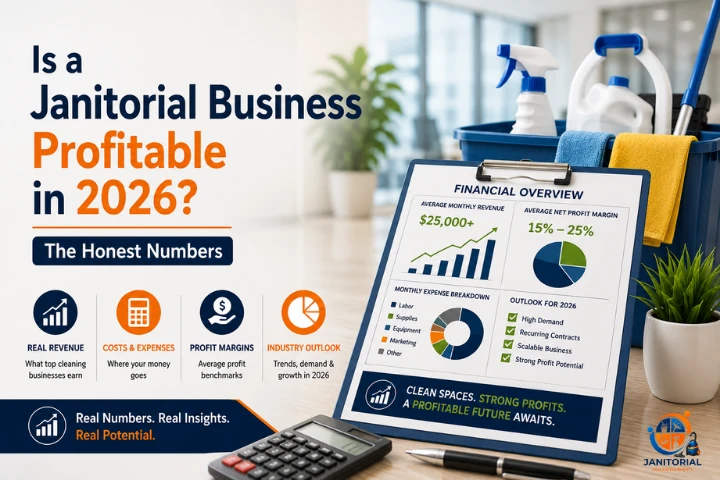
Short answer: Yes, but not automatically. A janitorial business can run at a healthy 15 to 25 percent margin, or it can quietly bleed money every month while looking busy on paper. The difference almost never comes down to the industry. It comes down to pricing, payroll management, and how many accounts you can service without your costs outrunning your revenue.
This guide breaks down the real numbers behind janitorial and commercial cleaning business profitability in 2026 — what owners actually earn, what eats into margin, and what separates the businesses that scale from the ones that stall.
1. Is a Cleaning Business Profitable? What the Data Actually Shows
Yes — the broader cleaning industry is genuinely profitable. The global cleaning services market is projected to reach roughly $480 billion in 2026, and demand keeps climbing as more offices outsource sanitation instead of managing it in-house.
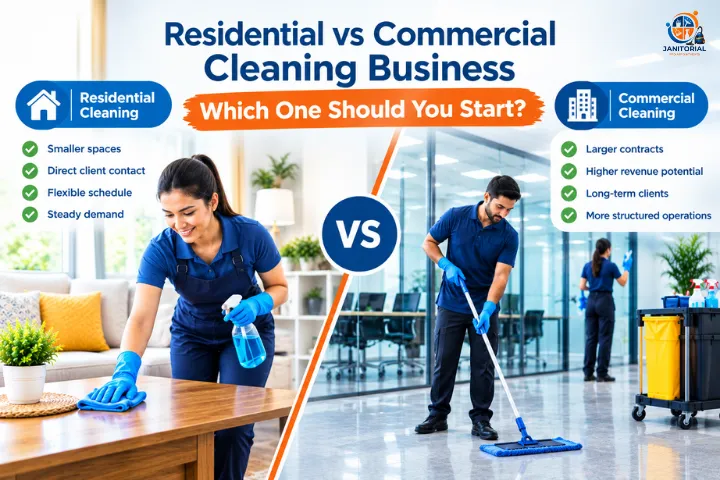
Residential cleaning businesses typically report profit margins between 25 and 40 percent, largely because overhead stays low when the owner is doing the cleaning themselves. Janitorial and commercial cleaning businesses run leaner — usually 10 to 25 percent — because payroll, insurance, and equipment costs scale with every new account.
| 🗣️ Insight Roughly 64% of cleaning companies report annual revenue under $100,000, while specialty niches like medical facility cleaning and post-construction cleanup consistently post higher margins due to lower competition. — Industry market data, 2026 |
2. Cleaning Business Profit Margin by Business Type
Profit margin depends heavily on what kind of cleaning business you run and how it is structured. Here is how it breaks down:
| Business Type | Typical Margin | Why |
|---|---|---|
| Solo residential cleaner | 25–40% | Low overhead, you do the labor yourself |
| Small janitorial team (2–10 employees) | 10–20% | Payroll burden eats into margin fast |
| Established commercial contractor | 15–25% | Efficiency of scale, better contract pricing |
| Specialty niche (medical, post-construction) | 25–35% | Less competition, higher rates per job |
| Franchise operator | 8–15% | Royalty fees and brand costs cut into profit |
| 💡 Pro Tip If your margin is under 10 percent and you are not a franchise, the problem is almost always pricing — not the industry. Revisit your bid math before assuming the business model does not work. |
3. How Much Do Cleaning Business Owners Actually Make?
This is the number most guides avoid giving straight. Here is a realistic revenue and profit breakdown by business stage:
| Business Stage | Monthly Revenue | Monthly Profit (approx.) |
|---|---|---|
| Solo operator, 3–5 accounts | $3,000 – $6,000 | $1,200 – $2,400 |
| Small team, 10–20 accounts | $15,000 – $30,000 | $2,000 – $5,000 |
| Established, 30+ accounts | $50,000 – $100,000+ | $8,000 – $20,000+ |
| Large commercial contractor | $200,000+ | $25,000 – $50,000+ |
These numbers assume standard commercial janitorial pricing and typical payroll costs. Specialty services — medical facility cleaning, biohazard cleanup, post-construction — can push profit meaningfully higher per account.
→ For current market rates by facility type, see our commercial cleaning rates guide.
4. What Makes a Janitorial Business Profitable — And What Kills It
What Drives Profitability
- Recurring commercial contracts — Predictable monthly revenue beats one-off residential jobs every time.
- Accurate bidding — Businesses that price by real labor cost, not a square-foot guess, protect their margin from day one.
- Low employee turnover — Rehiring and retraining costs quietly drain profit that never shows up as a line item.
- Specialty niches — Medical, post-construction, and biohazard cleaning command higher rates with less competition.
What Kills Profitability
- Underbidding to win contracts — A full calendar with thin margins is worse than a smaller calendar with healthy ones.
- Ignoring payroll burden — Taxes, workers comp, and insurance add 20 to 30 percent on top of wages, and skipping this in your pricing guarantees a loss.
- High employee turnover — Constant hiring and retraining is one of the most underestimated cost centers in this industry.
- No systems — Manual scheduling and invoicing at scale burns owner time that should go toward sales and account management.
| ⚠️ Warning The businesses that fail are rarely in a bad industry. They are almost always underpricing contracts to stay competitive, then discovering the math does not work once payroll and supplies are factored in. |
5. Franchise vs Independent — Which Is More Profitable?
Franchise systems like Jan-Pro, Coverall, and Stratus Building Solutions offer brand recognition and a built-in sales pipeline, but royalty fees typically run 5 to 10 percent of revenue on top of standard operating costs. That usually caps franchise margins around 8 to 15 percent.
Independent janitorial businesses keep more of every dollar, but they are also responsible for their own lead generation, sales, and brand building from day one. For most owners with sales experience or a lead generation partner, independent operation is more profitable long term.
6. How to Improve Your Cleaning Business Profit Margin
- Audit your pricing annually — Labor costs and supply prices rise every year. If your rates have not moved with them, your margin is shrinking quietly.
- Upsell existing accounts — Floor care, window cleaning, and disinfection add-ons increase revenue per account without the cost of acquiring a new client.
- Reduce turnover — Better pay structure and clear expectations cost less than constant rehiring and retraining.
- Target recurring commercial contracts over one-off jobs — Predictable revenue is easier to plan around and typically carries better margins at scale.
→ If your pricing process needs work, our guide on how to bid on janitorial contracts breaks down the exact formula for pricing a job so it protects your margin.
| 💡 Pro Tip Track your numbers by account, not just total revenue. Some contracts that look profitable on paper are actually losing money once labor and supply costs are allocated correctly. |
Bottom Line
Is a janitorial business profitable? Yes — commercial cleaning is one of the more accessible, recession-resistant businesses to start, with real demand and low barriers to entry. But profitability is not automatic. It comes from accurate bidding, disciplined payroll management, and building a base of recurring commercial accounts instead of chasing one-off jobs.
Getting profitable contracts starts with getting in front of the right clients.
Janitorial Pro Appointments connects cleaning businesses across the US with verified, appointment-ready commercial leads — so your calendar fills with accounts worth having.
Start filling your calendar with qualified leads → [ Get a Free Quote ]